
Options Backtesting Without Writing Code
GreeksLab is an options backtester. You describe a trade and the rules for opening and closing it, and it replays those rules against more than a decade of market data recorded minute by minute, then reports what happened. Nothing to install, and nothing to program.
Free accounts run unlimited backtests for 30 days. No card needed.
- 2012
- History starts in January, updated every day
- 1 min
- Every contract repriced once a minute
- No code
- Rules are picked from a list, not written
- 30 days
- Free account, unlimited backtests, no card
What is options backtesting?
Options backtesting is running a fixed set of trading rules against past market data to record what those rules would have done. The result is a history of trades you never placed: what opened, what closed, and what each one made or lost.
Options make this harder to do than shares. A single position can hold several contracts at once, each with its own strike and its own expiration date, and every one of them changes price as the market moves, as the day runs down, and as the market revises how much movement it expects next. A backtest is only as honest as its handling of those three at once.
How to backtest options strategies
Five steps, in the order you do them.
- 01
Describe the trade
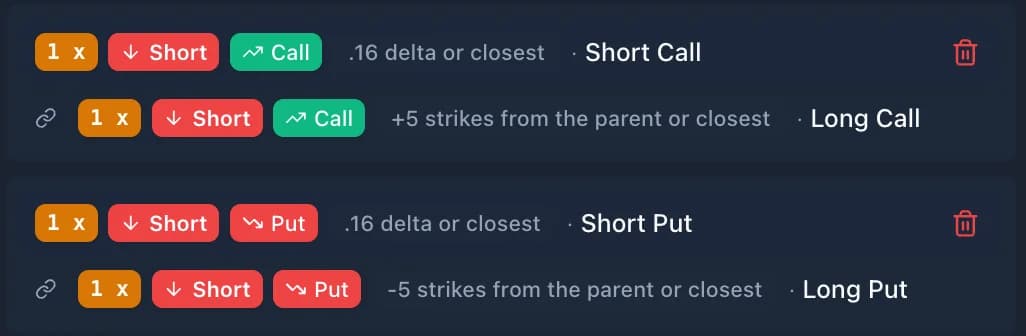
A position is built from legs, and a leg is one option contract that you either buy or sell. You choose its strike, the price the contract is settled against, in whichever way you already think about it: a set distance from the market, a percentage away from it, the premium you want the contract to pay, or by delta if you work that way. Link two legs to hold them a fixed distance apart. Four legs and you have an iron condor.
- 02
Set when it opens
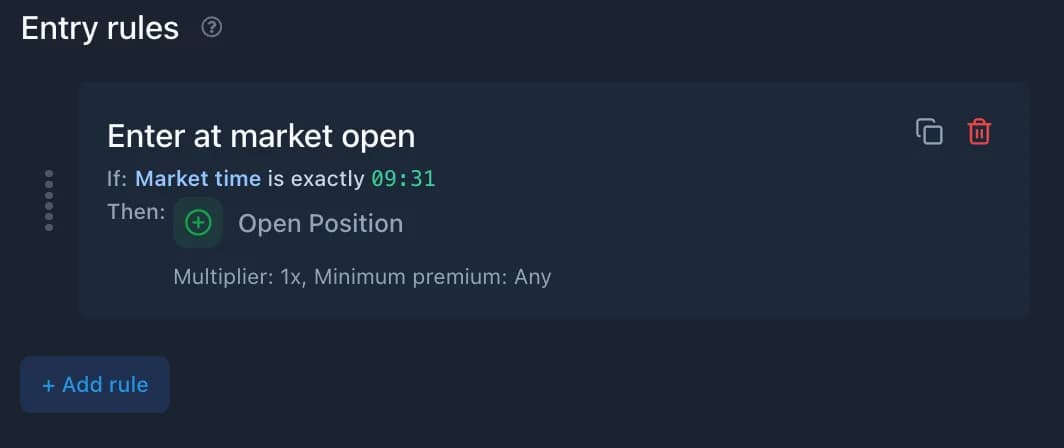
An entry rule is a set of conditions and the action they trigger. Open at ten in the morning. Open only when the market gapped overnight. Open only when volatility is above a level you choose. The first rule that matches is the one that fires that day. Size the trade as a fixed number of contracts, as a target premium, or as a share of the account balance that is recalculated daily.
- 03
Set when it closes
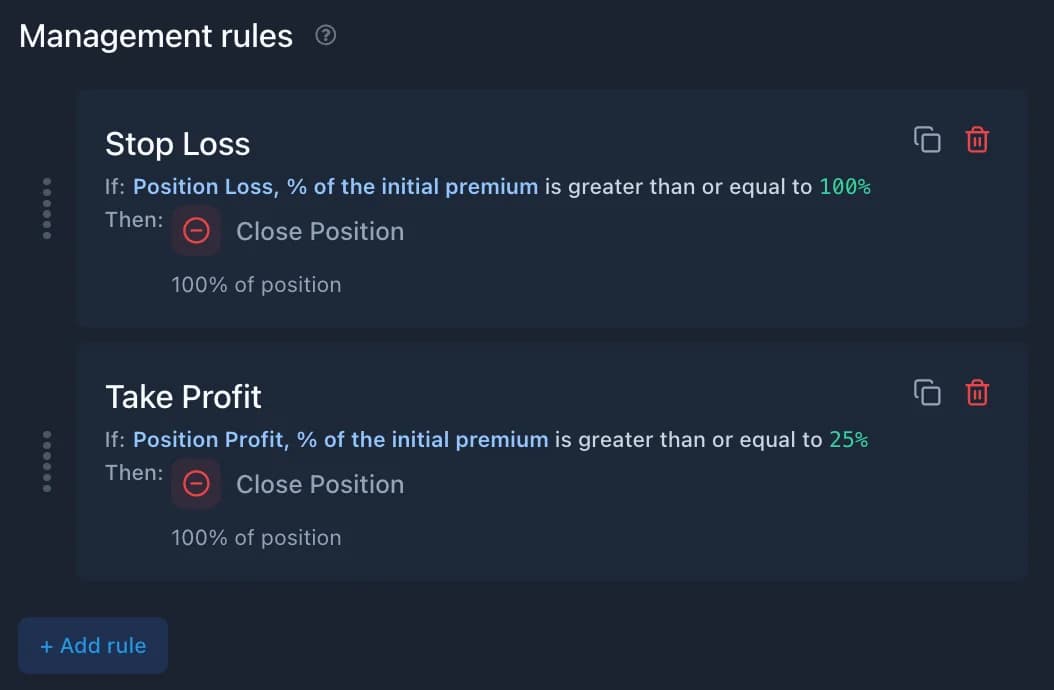
Take profit once the position has earned back half the credit it collected. Stop out if the loss reaches twice that credit. Close an hour before expiration. You can close the whole position, close a single leg, or move a leg to a different strike. Rules run in the order you give them, and every rule whose conditions are met gets its turn.
- 04
Set the period and the trading costs
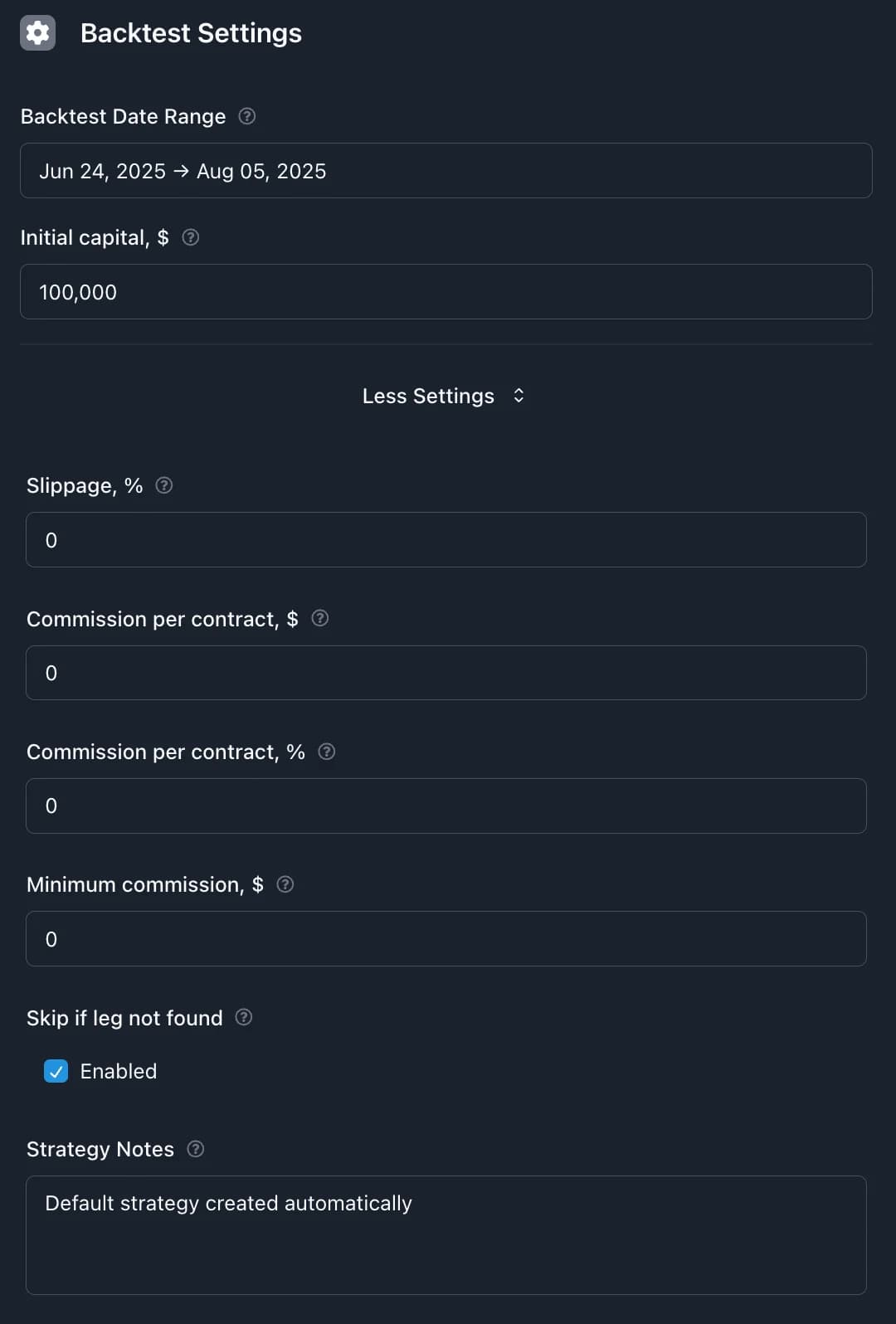
Choose the date range and the starting balance, then enter your commissions and your slippage, the gap between the price you see and the price you actually get. Both come off every fill. Running the same strategy again at worse fills is the quickest way to find out how much of a result depends on getting good ones.
- 05
Read the results
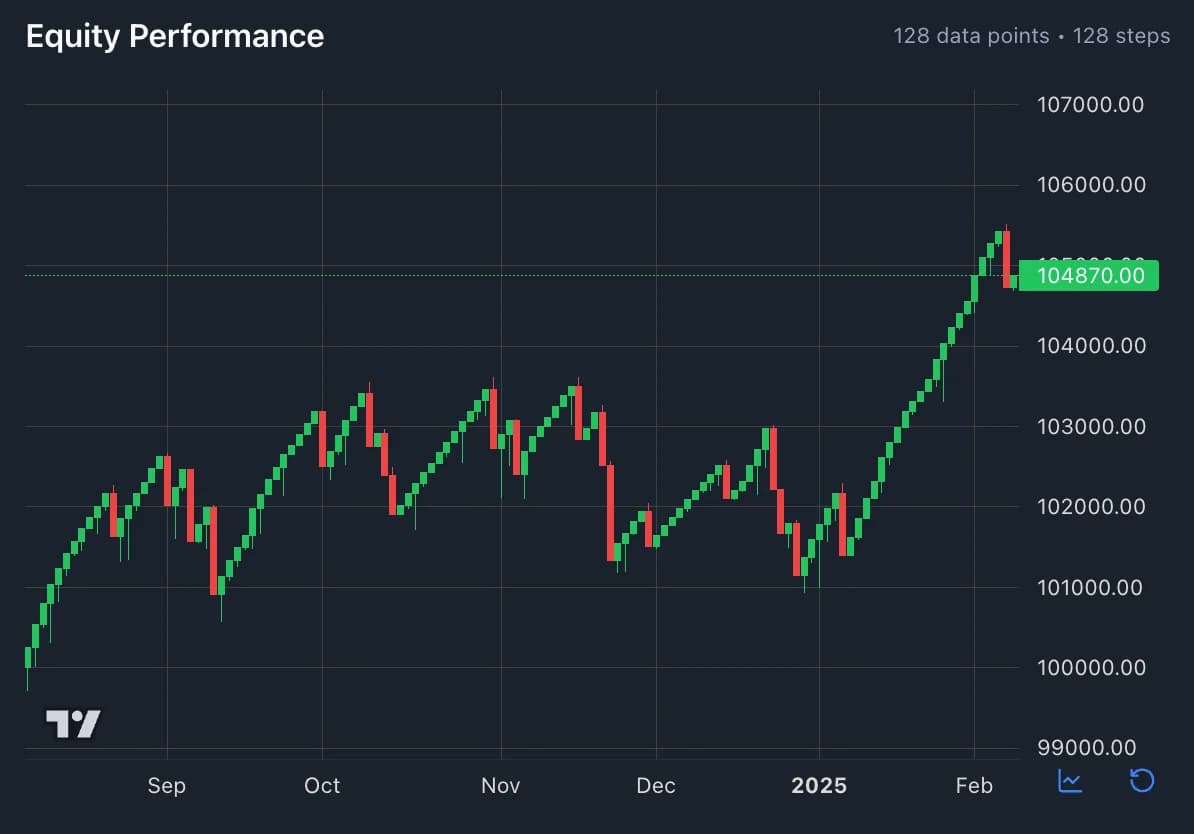
An equity curve, a drawdown chart, a month-by-month table, the spread of daily results, and every position the rules opened and closed. Open any one of those trades to see the prices it filled at, the risk measures at the moment it was executed, and the rule that ended it.
The data behind every backtest
Every trading day since January 2012, updated daily, with every contract in the chain repriced once a minute: the price to buy, the price to sell, the midpoint between them, the standard risk measures traders watch, and the market's expectation of future movement, with the level of the index and its volatility index alongside.
The contracts are S&P 500 weekly index options, listed as SPXW. They expire every business day and settle in cash rather than in shares, which is what makes them the usual vehicle for same-day expiration trading. Nothing else is in the dataset: no single-stock options and no ETF options.
What a finished backtest tells you
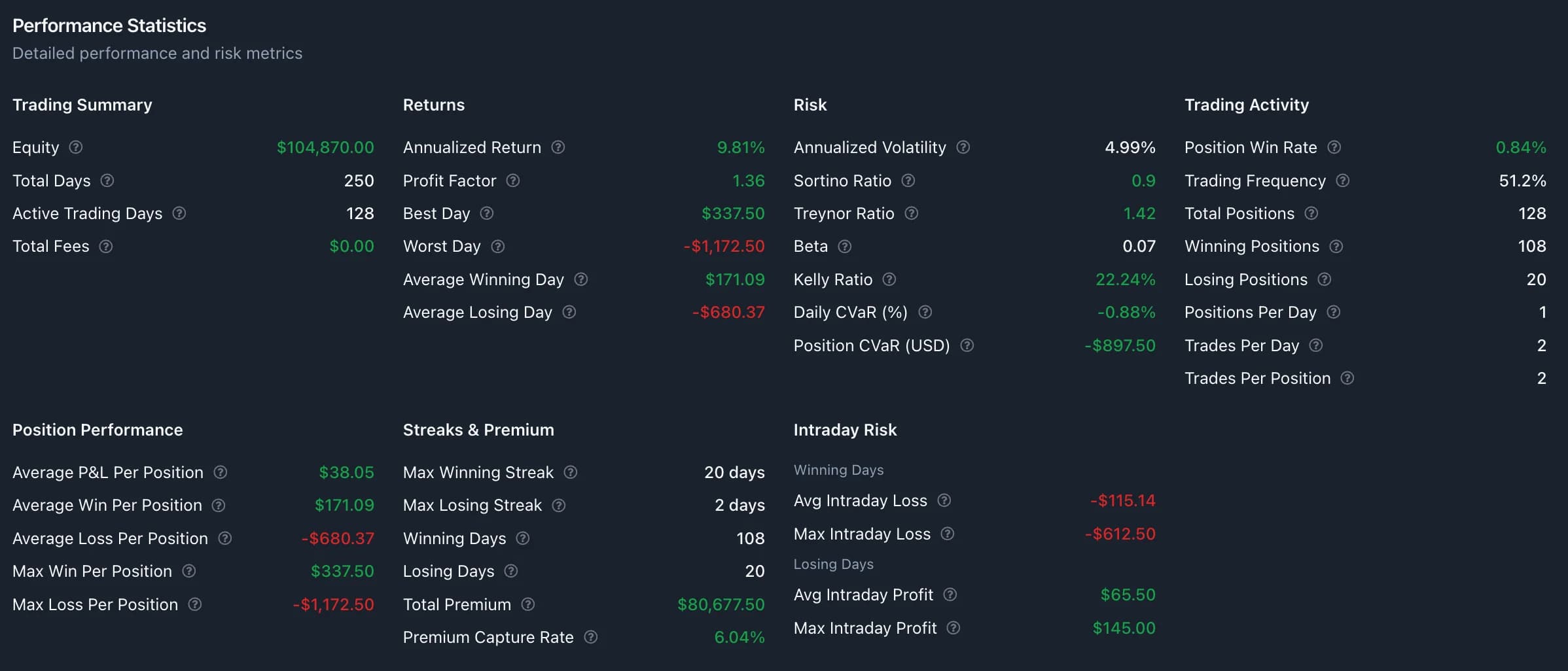
Underneath the charts sit the numbers that decide whether a strategy is worth trading at all.
- Total and average profit
- What the rules made across the period, and what a typical day contributed.
- Win rate
- The share of days that finished ahead. On its own it settles very little, because one bad day can outweigh many good ones.
- Profit factor
- Everything won divided by everything lost. Above 1 means the winners covered the losers.
- Maximum drawdown
- The deepest fall from a high point to the low that followed it.
- Sharpe and Sortino
- Return measured against how much the balance moved around to get there. Sortino counts only the downward moves.
- CVaR
- The average of the worst 5% of days. Maximum drawdown reports the single deepest hole; this reports the shape of the whole bad tail.
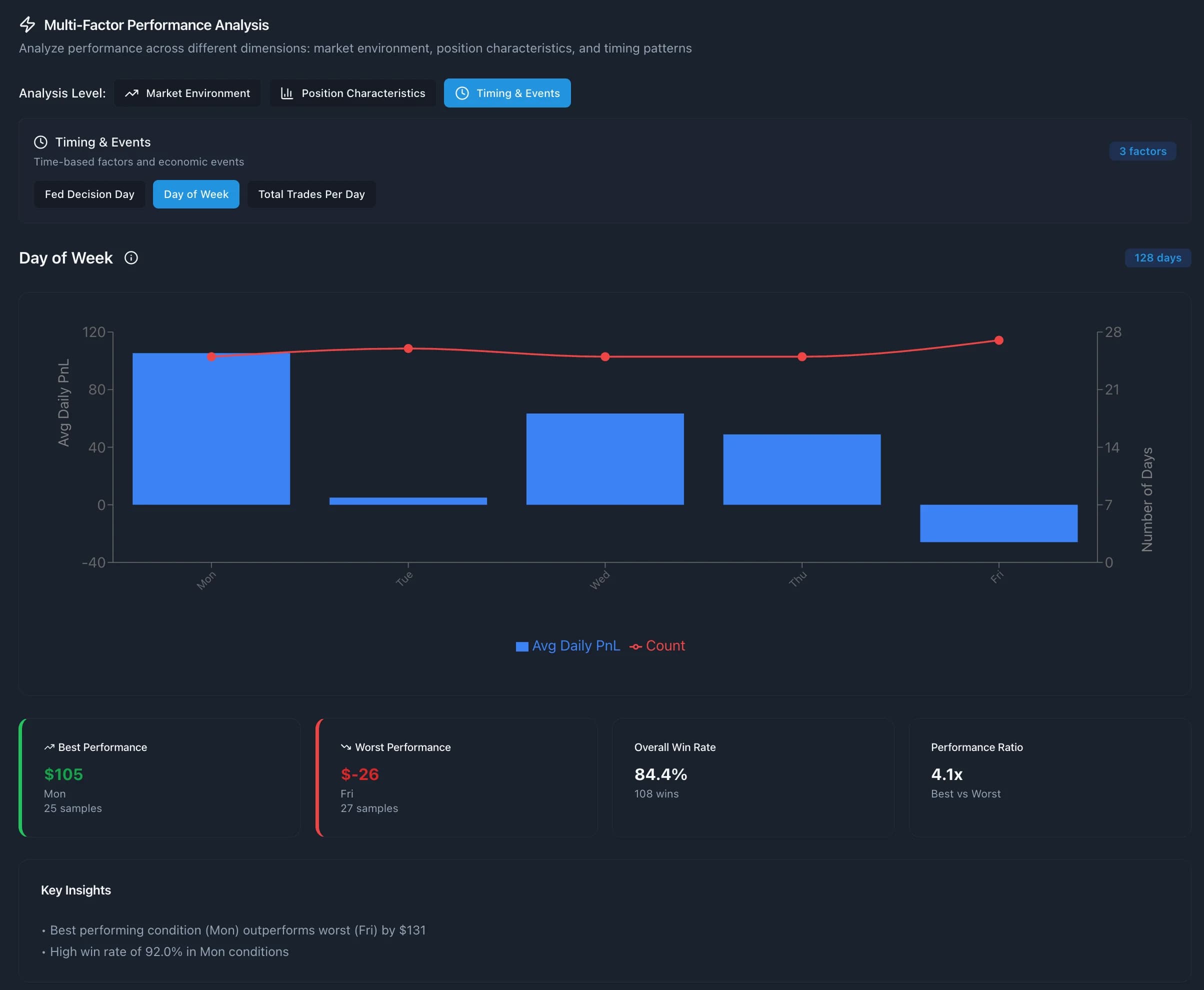
A single profit number hides which days earned it. Results are split across twenty factors, so the same strategy can be read against the day of the week, whether the Federal Reserve was meeting, how volatile the market was at the open, how far it gapped overnight, how long each trade stayed open, and how much premium it collected. This is often where one strategy turns out to be two, only one of which was working.
You can put two backtests side by side, which is usually what settles whether a change helped, and you can merge several into one weighted portfolio. The metrics for that portfolio are recalculated from the combined daily results rather than averaged across the separate runs, and a correlation table shows how much the strategies overlap.
Free options backtesting
A free account runs unlimited backtests for 30 days and asks for no card. It uses the same engine and the same minute-by-minute data as the paid plans, over a shorter slice of history that starts in 2022.
Paid plans open the full record back to 2012, run more backtests at once, and lift the size limit on a strategy. See the plans.
Who it suits
This fits if you trade the S&P 500 index on the day its options expire and have a rule you want to check. Credit spreads, iron condors, straddles and strangles, butterflies, and positions you adjust part-way through all fit the model.
It fits too if you trade XSP or SPY, which follow the same index through the session. Entry timing, strike distance and exit rules carry across. Contract size and the way the trade is settled do not, so your own results will not match the test exactly. The differences are written up in SPX vs SPY vs QQQ.
GreeksLab gives no signals and screens for nothing. You bring the rules. A backtest reports what already happened, and whether that says anything about what happens next is your judgement to make. Read the risk disclosure.
Common questions
Do I need to know how to program?
No. Conditions and actions are picked from a list. Anything the list does not cover can be written in the expression editor, which works in arithmetic and comparisons rather than a programming language you would have to learn first.
Is there a free version?
A free account runs unlimited backtests for 30 days and asks for no card. It uses the same engine and the same minute-by-minute data as the paid plans, over a shorter slice of history that starts in 2022. Paid plans open the full record back to 2012, run more backtests at once, and lift the size limit on a strategy. See the plans.
Which contracts can I backtest?
S&P 500 weekly index options, listed as SPXW. They expire every business day and settle in cash rather than in shares, which is what makes them the usual vehicle for same-day expiration trading. Single-stock options and ETF options are not in the dataset, although XSP and SPY follow the same index closely enough that a result on SPX still tells you something.
How far back does the data go, and how detailed is it?
Every trading day since January 2012, with every contract in the chain repriced once a minute: the price to buy, the price to sell, the midpoint between them, the standard risk measures, the market's expectation of future movement, and the level of the index and its volatility index alongside.
Can I test multi-leg strategies and adjustments?
Yes. Iron condors, credit spreads, straddles, strangles and butterflies, with uneven leg ratios where you need them and linked legs that stay a fixed distance apart. One strategy can run several positions at once, and a position can move a leg or close part of itself while the trade is still open.
Are commissions and slippage included?
Both come off every fill, and both are numbers you set. Commission is charged per contract, so it grows with the number of legs: at 65 cents a contract, a four-leg condor costs $5.20 to open and close. Slippage is what you give up crossing the spread. Running the same test at several slippage levels shows how much of a result rests on good fills.
Can I compare two backtests?
Two to ten at a time, side by side, which is usually what settles whether a change helped. They can also be merged into a single weighted portfolio, with the metrics recalculated from the combined daily results rather than averaged across the separate runs. A correlation table shows how much the strategies overlap, and it needs at least 30 shared trading days before it will report anything.
Run your first backtest
GreeksLab is options backtesting software built for traders rather than programmers. The quick start puts a strategy together and tests it in about five minutes.